
ABC Atlas
The Allen Brain Cell (ABC) Atlas provides a platform for visualizing multimodal single cell data across the mammalian brain and aims to empower researchers to explore and analyze multiple whole-brain datasets simultaneously. This open science resource, developed by the Allen Institute as part of the Brain Knowledge Platform, allows unprecedented insights into the enormous diversity of cell types in the brain and where they are.
As the Allen Institute and its collaborators continue to add new modalities, species, and insights to the ABC Atlas, this groundbreaking platform will keep growing, opening up endless possibilities for discoveries and breakthroughs in neuroscience.
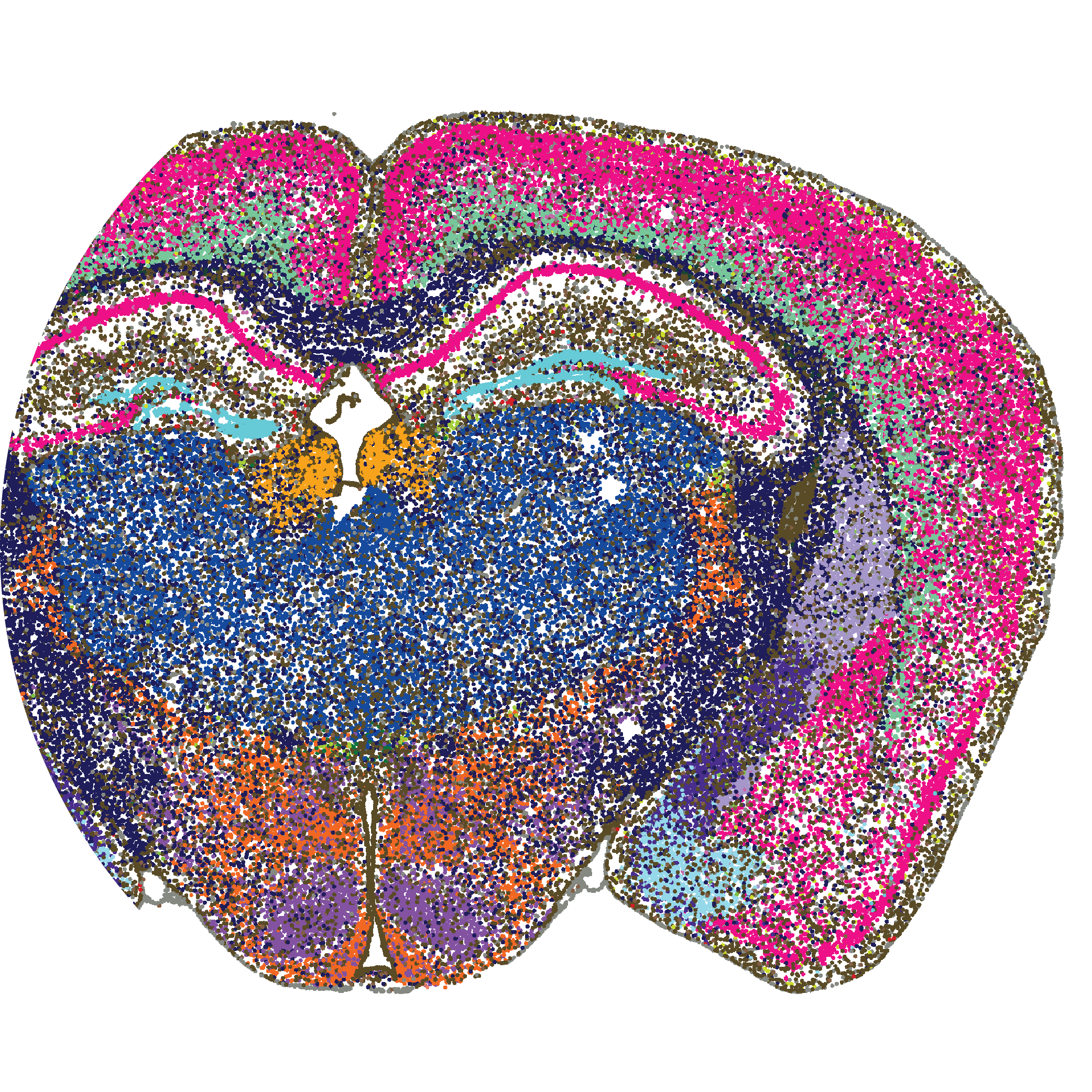
Mouse Whole-Brain Transcriptomic Cell Type Atlas
Yao et al. (2023)
The Mouse Whole Brain Atlas is a high-resolution transcriptomic and spatial cell-type atlas across the entire mouse brain, integrating several whole-brain single-cell RNA-sequencing (scRNA-seq) datasets. The datasets contain a total of ~4 million cells passing rigorous quality-control (QC) criteria. The integrated transcriptomic taxonomy contains 5,322 clusters that are organized in a hierarchical manner with nested groupings of 34 classes, 338 subclasses, 1,201 supertypes and 5,322 types/clusters. The scRNA-seq data reveal transcriptome-wide gene expression and co-expression patterns for each cell type. The anatomical location of each cell type has been annotated using a comprehensive brain-wide MERFISH dataset with a total of ~4 million segmented and QC-passed cells, probed with a 500-gene panel and registered to the Allen Mouse Brain Common Coordinate Framework (CCF v3). The MERFISH data not only provide accurate spatial annotation of cell types at subclass, supertype and cluster levels, but also reveal fine-resolution spatial distinctions or gradients for cell types.
The combination of scRNA-seq and MERFISH data reveals a high degree of correspondence between transcriptomic identity and spatial specificity for each cell type, as well as unique features of cell type organization in different brain regions.
A detailed cell type annotation table is also provided along with data downloads (GitHub), detailing information about the hierarchical membership, anatomical annotation, neurotransmitter type, cell type marker genes, transcription factor and neuropeptide markers, and other metadata types for each cluster. Learn more...
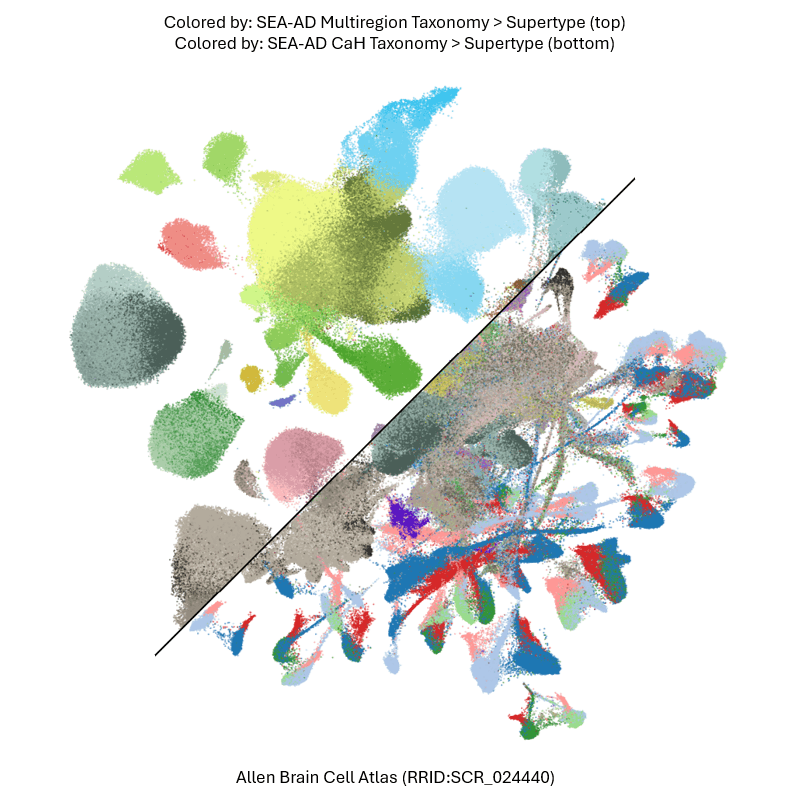
New! SEA-AD: neo-/allo-cortex and caudate nucleus in human
Travaglini, Gabitto, Ding, et al. (2026) | Kana et al. (2026)
Two new SEA-AD data sets have been added to the existing middle temporal gyrus data sets as of summer 2026: 1) a single nucleus transcriptomic atlas of ~6 million cells spanning ten neo- and allocortical brain regions across the spectrum of Alzheimer's disease, which extends the SEA-AD MTG taxonomy; and 2) a single nucleus transcriptomic data set of ~800,000 cells from the caudate nucleus of a 42-donor subset of the original SEA-AD cohort, selected to minimize comorbidities with other known brain diseases. Learn more...
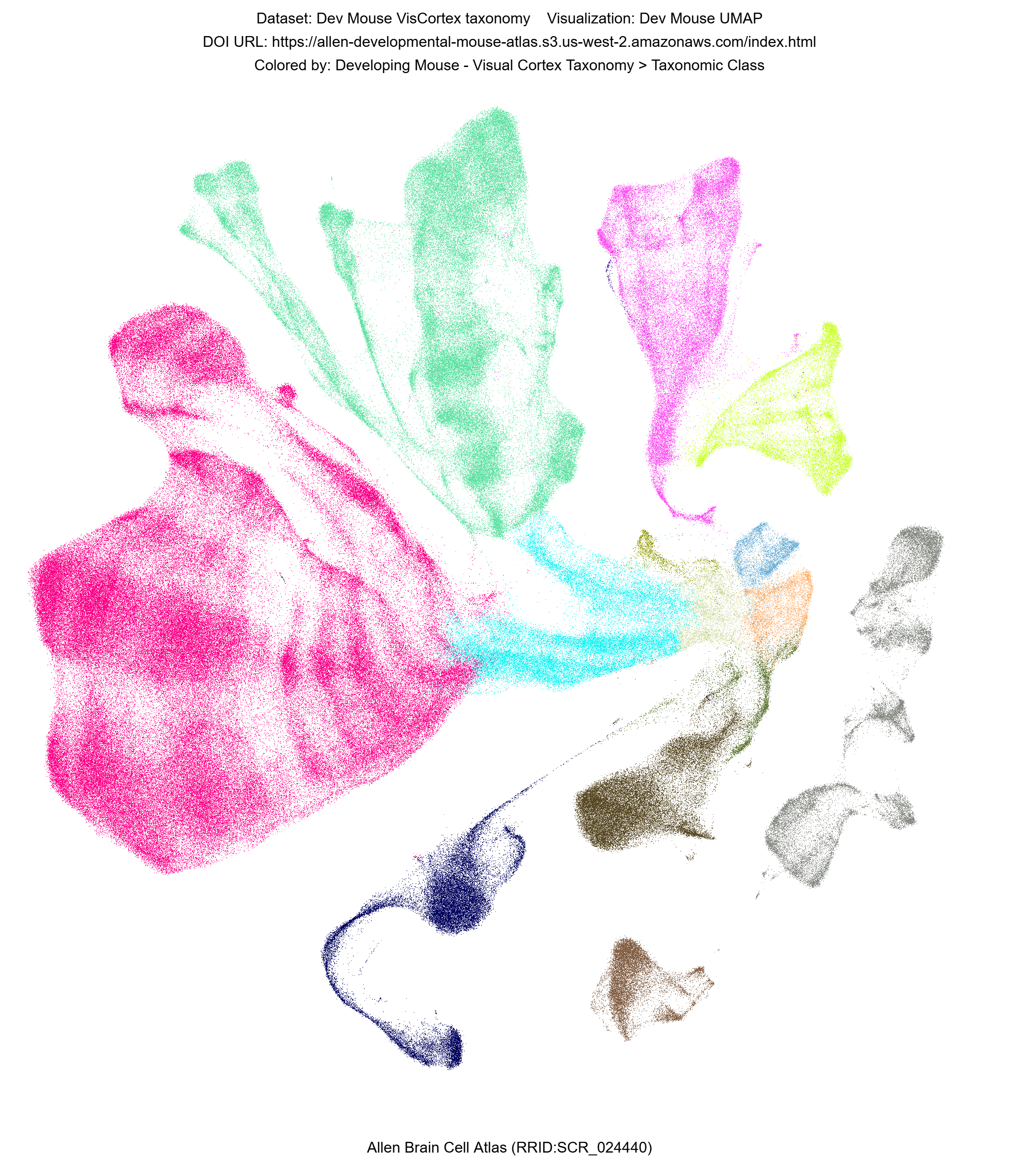
New! Developing Mouse Brain: Visual Cortex
The Developing Mouse - Visual Cortex taxonomy data is now available to the public in the ABC Atlas. It is derived from a single cell transcriptomic dataset containing 568,654 cells from 53 donors ranging in age from embryonic to adult. This release is part of an initiative to create a high-quality atlas of cell types in the mouse visual cortex and thalamus across development using large scale single cell transcriptomic analysis. Read more about this research at DOI: 10.1038/s41586-025-09644-1 and check out the new resources below.
%20(1).png)
Transcriptomic Diversity of Cell Types in the Adult Human Brain
This dataset includes more than three million cells sampled from the adult human brain. Samples were isolated from ~100 dissections from three donors and assayed using single-nucleus RNA sequencing. The resulting cells were clustered into hierarchical groups of 31 superclusters, 461 clusters, and 3313 subclusters. Additionally, categorical neurotransmitter type annotations were assigned to clusters based on expression (or lack thereof) of one or more neurotransmitter-associated marker genes. Included in this dataset includes two tSNE plots - one plot contains approximately 900k non-neuronal cells and the other contains approximately 2.5m neuronal cells. Learn more...

More Data to Explore in ABC Atlas
Collection
Description
Species
See it in ABC Atlas
Programmatic Access
MERFISH whole mouse brain
This spatially resolved cell atlas of the whole mouse brain provides a systematic characterization of the spatial organization of transcriptomically defined cell types across the entire adult mouses brain using in situ, single-cell transcriptomic profiling with multiplexed error-robust fluorescence in situ hybridization (MERFISH). Zhuang imaged ~9 million cells with a ~1,100-gene panel using MERFISH and performed spatially resolved, single-cell expression profiling at the whole-transcriptome scale by integrating our MERFISH data with the whole-brain single-cell RNA-sequencing (scRNA-seq) dataset generated by the Allen Institute. This allowed them to generate a comprehensive cell atlas of >5,000 transcriptionally distinct cell clusters, belonging to ∼300 major cell types (subclasses), in the whole mouse brain with high molecular and spatial resolution. The cell atlas was further registered to the Allen Mouse Brain Common Coordinate Framework (CCF v3), which allows systematic quantifications of the cell composition and organization in individual brain regions as anatomically delineated in the CCF v3. This cell atlas also reveals molecularly defined brain regions characterized by distinct cell-type compositions, spatial gradients featuring gradual changes in the gene-expression profiles of cells, as well as cell-type-specific cell-cell interactions and the molecular basis and functional implications of these cell-cell interactions. Learn more...
Mouse
Cellular and Molecular Characterization of the Aged Mouse Brain
This data accompanies the January 2025 paper Brain-wide cell-type-specific transcriptomic signatures of healthy ageing in mice published in Nature.
The Cellular and Molecular Characterization of the Aged Mouse Brain project seeks to create a foundational reference for the transcriptional and epigenomic changes that occur in the brain with normal aging. Single cell gene expression and chromatin accessibility measurements survey neuronal and non-neuronal cell classes/types across the entire mouse brain to reveal areas and cell types that are more susceptible to aging than others. This is a comprehensive single-cell RNA-sequencing (scRNA-seq) dataset containing 1.2 million high-quality single-cell transcriptomes of brain cells from aged (18mo) and young adult (2mo) mice of both sexes, from regions spanning the forebrain, midbrain, and hindbrain. Learn more...
Mouse
The Seattle Alzheimer’s Disease Brain Cell Atlas
The Seattle Alzheimer’s Disease Brain Cell Atlas (SEA-AD) is a consortium focused on gaining a deep molecular and cellular understanding of the early pathogenesis of Alzheimer’s Disease. SEA-AD is a collaboration of the Allen Institute for Brain Science, the University of Washington Alzheimer’s Disease Research Center, and Kaiser Permanente Washington Research Institute.
Using the ABC Atlas, users can explore the largest cell-resolution spatial transcriptomics (MERFISH) data set in human brain to date, which provides accurate spatial annotation and colocalization of cell types in the middle temporal gyrus (MTG) of 24 donors from the SEA-AD cohort. This can be viewed in parallel with the 2.78 million cells collected from MTG and dorsolateral prefrontal cortex (DFC) using single nucleus transcriptomics and multiomics (from 84 donors), and organized into a joint taxonomy to allow exploration of gene expression in the context of cell types and donor metrics.
As of summer 2026, users can also explore a high-resolution transcriptomic atlas of ~6 million cells spanning ten neo- and allocortical brain regions across the spectrum of Alzheimer's disease, which extends the SEA-AD MTG taxonomy described above. A companion dataset profiles ~800,000 single cells from the caudate nucleus of a 42-donor subset of the original SEA-AD cohort, selected to minimize comorbidities with other known brain diseases. Learn more...
Human
Transcriptomic diversity of cell types in adult human brain
This dataset includes more than three million cells sampled from the adult human brain. Samples were isolated from ~100 dissections from three donors and assayed using single-nucleus RNA sequencing. The resulting cells were clustered into hierarchical groups of 31 superclusters, 461 clusters, and 3313 subclusters. Additionally, categorical neurotransmitter type annotations were assigned to clusters based on expression (or lack thereof) of one or more neurotransmitter-associated marker genes. Included in this dataset includes two tSNE plots - one plot contains approximately 900k non-neuronal cells and the other contains approximately 2.5m neuronal cells... Learn more...
Human
ASAP Human Postmortem-Derived Brain Sequencing Collection
The Aligning Science Across Parkinson’s (ASAP) initiative, Allen Institute, and the Michael J. Fox Foundation are teaming up to help researchers unlock deeper insights into how cell types, brain anatomy, and diseases like Parkinson’s are connected.
This initial collaboration focuses on the Human Postmortem-derived Brain Sequencing Collection (PMDBS), a harmonized repository comprised of single nucleus and PolyA RNA-seq data contributed by five ASAP CRN teams (Hafler, Lee, Jakobsson, Scherzer, Hardy). Sequencing data were uniformly aligned to the GRCh38.p13 reference genome (Gencode V32), quality control was performed and low-quality cells were filtered out. A set of highly variable genes were identified and the scVI workflow resulted in an integrated latent variable representation, 2D UMAP coordinates and a set of 30 clusters. Currently, the repository spans roughly 3 millions cells obtained from 9 brain regions and 211 donors with various pathologies (including healthy control). For more details on this dataset and to access the raw data used in its preparation, please visit the collection description on the ASAP CRN Cloud webpage. Learn more...
Human
Mouse whole-brain transcriptomic cell type atlas
The Mouse Whole Brain Atlas is a high-resolution transcriptomic and spatial cell-type atlas across the entire mouse brain, integrating several whole-brain single-cell RNA-sequencing (scRNA-seq) datasets. The datasets contain a total of ~4 million cells passing rigorous quality-control (QC) criteria. The integrated transcriptomic taxonomy contains 5,322 clusters that are organized in a hierarchical manner with nested groupings of 34 classes, 338 subclasses, 1,201 supertypes and 5,322 types/clusters. The scRNA-seq data reveal transcriptome-wide gene expression and co-expression patterns for each cell type. The anatomical location of each cell type has been annotated using a comprehensive brain-wide MERFISH dataset with a total of ~4 million segmented and QC-passed cells, probed with a 500-gene panel and registered to the Allen Mouse Brain Common Coordinate Framework (CCF v3). The MERFISH data not only provide accurate spatial annotation of cell types at subclass, supertype and cluster levels, but also reveal fine-resolution spatial distinctions or gradients for cell types.
The combination of scRNA-seq and MERFISH data reveals a high degree of correspondence between transcriptomic identity and spatial specificity for each cell type, as well as unique features of cell type organization in different brain regions.
A detailed cell type annotation table is also provided along with data downloads (GitHub), detailing information about the hierarchical membership, anatomical annotation, neurotransmitter type, cell type marker genes, transcription factor and neuropeptide markers, and other metadata types for each cluster. Learn more...
Mouse
Developing Mouse: Visual Cortex Taxonomy
The Developing Mouse: Visual Cortex taxonomy is derived from a single cell transcriptomic dataset containing 568,654 cells from 53 donors ranging in age from embryonic to adult.
This dataset is part of an initiative to create a high-quality atlas of cell types in the mouse visual cortex and thalamus across development using large scale single cell transcriptomic analysis. All of the cells in this dataset were collected from wild-type C57Bl6/j mice.
Cells were collected from at 25 time points spanning ages E11.5 to postnatal day 28 (P28). At ages E11.5 to E14.5 the entire brain was dissected and cells were prepared for sequencing using the 10x Genomics platform. At ages E15.5 to P28 we dissected out either visual cortex or thalamus and prepared cells for sequencing using the 10x Genomics platform. This dataset covers the visual cortex.
The cell-type assignment is a four level taxonomy defining 15 classes, 40 subclasses, 148 clusters and 714 subclusters. This cell-type assignment is broadly consistent with those from the previous studies from the Allen Institute for Brain Science, Whole Mouse Brain (WMB) and the Broad Institute whole mouse brain taxonomy at the subclass level while providing finer cell-type and temporal resolutions with additional subcluster annotations.
To generate this developing taxonomy, we applied the Quality Control (QC) and post-integration QC pipelines. Integration and label transfer of scRNA-seq between ages was performed using Seurat/scVI. Learn more...
Mouse