About SEA-AD
The Seattle Alzheimer’s Disease Brain Cell Atlas (SEA-AD) consortium strives to gain a deep molecular and cellular understanding of the early pathogenesis of Alzheimer’s disease. We provide free, open resources to the scientific community.
Want to learn more about SEA-AD. Watch this 7-minute video overviewing the project.
Our approach
SEA-AD aims to build a detailed map of brain cell types in aging and AD. This map will help us understand how the disease affects different cell populations and brain regions. To achieve this, SEA-AD is using advanced techniques to analyze brain tissue samples from carefully selected individuals with varying degrees of AD pathology. These approaches include:
- Next-generation single-cell molecular profiling technologies developed through the BRAIN Initiative Cell Census/Atlas Network (BICAN/BICCN) and at the Allen Institute for Brain Science.
- Application of spatial transcriptomic methods to Alzheimer's-affected tissue sections to define the spatial distribution of vulnerable cell types and reveal the impact on the structural and functional organization of tissue and circuit microarchitecture.
- Integrating single-cell profiling technologies with quantitative neuropathology and deep clinical phenotyping via collaboration with the University of Washington Alzheimer's Disease Research Center (ADRC) and Kaiser Permanente Washington Health Research Institute (KPWHRI).
Outputs of SEA-AD include manuscripts summarizing scientific findings, modified reference cell type taxonomies, and tools, data, and resources for exploration of our work that are freely available to the AD community.
SEA-AD Donor Cohort
SEA-AD selected a high-quality donor cohort, spanning the full spectrum of AD pathology, chosen from prospective longitudinal cohort studies with well-characterized participants. SEA-AD cohort was derived from longitudinally characterized research brain donors from the community-based Adult Changes in Thought (ACT) study and University of Washington Alzheimer's Disease Research Center (ADRC).
Highlights of the SEA-AD cohort
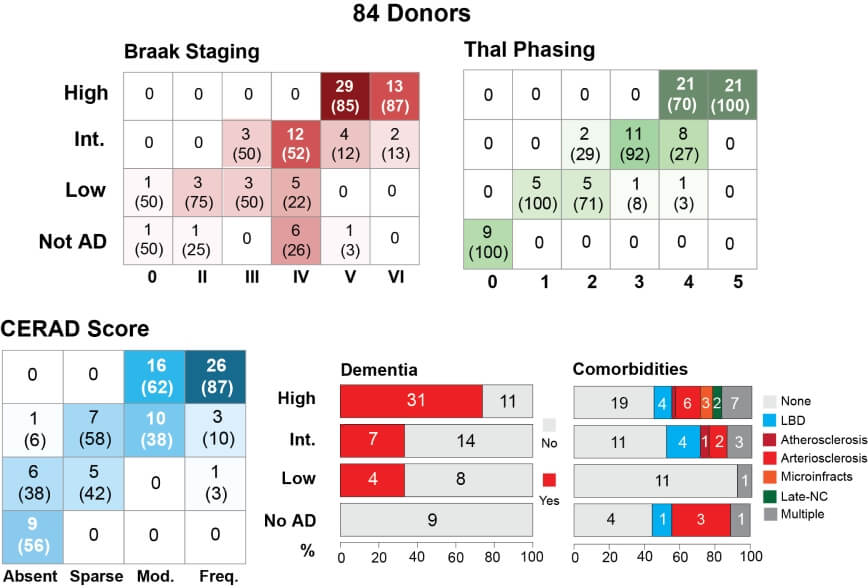
- Range of pathological levels:
- 9 No AD
- 12 Low
- 12 Intermediate
- 42 High ADNC (Alzheimer's Disease Neuropathologic Change score)
- 50% no dementia, 50% dementia
- Age of death, 65 - 102, mean: 88
- 51 females, 33 males
- Years of education: 12 - 21
- Extensive metadata (APOE genotype, Braak stage, CERAD score, Thal stage, 20+ more)
For more information on ACT study donors, please contact KPWA.actproposals@kp.org
For more information on ADRC donors, please contact uwadrc@uw.edu
Brain Regions Assayed
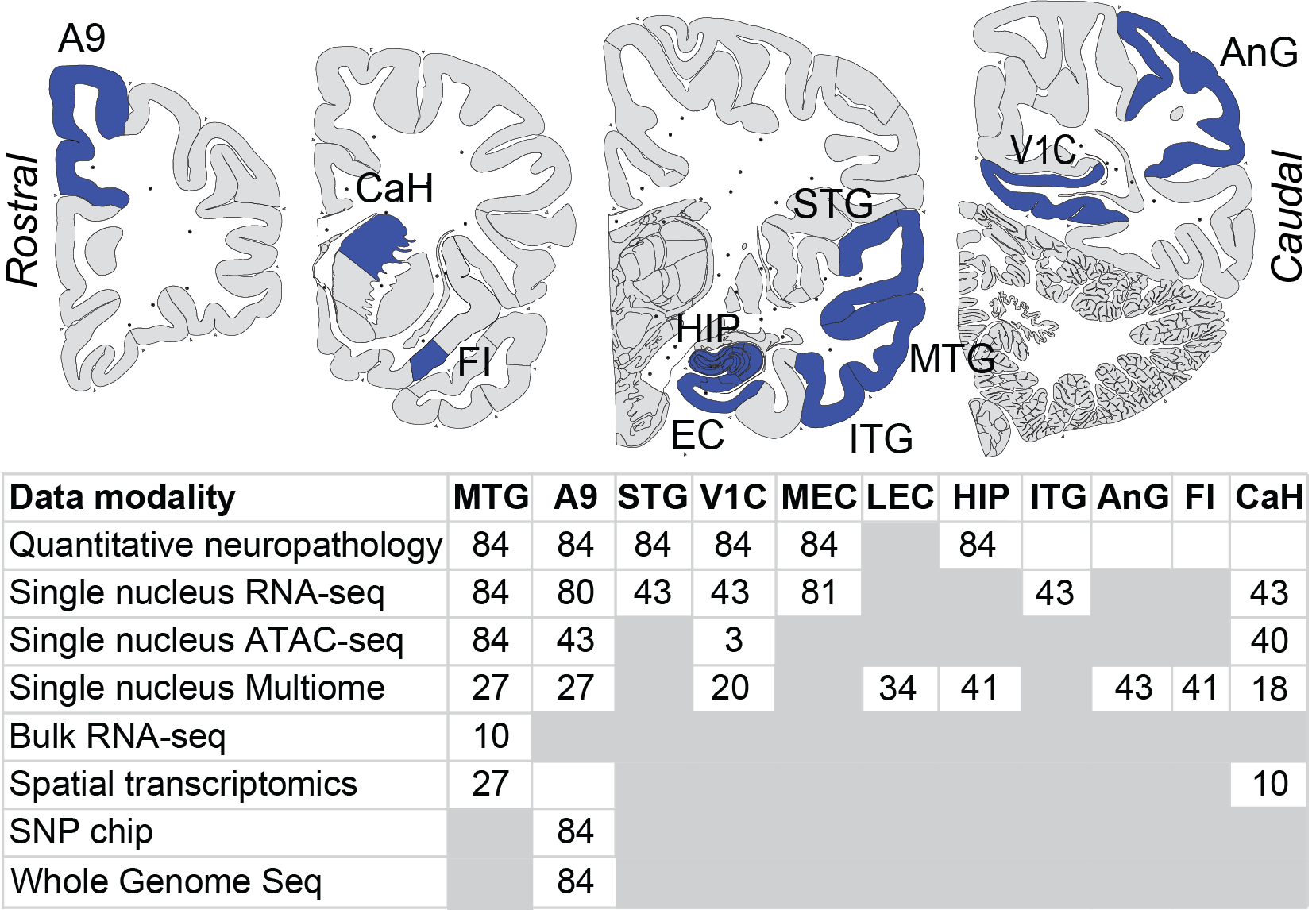
Several data and resources, and our initial publication focus on middle temporal gyrus (MTG), with additional data and select resources targeting many additional brain structures.
Values in the table indicate the number of SEA-AD donors. Note that snOmics data from 3-5 reference donors is also available for most regions. White boxes denote data being collected but not yet available, while gray boxes denote no data collection planned. Abbreviations: MTG, middle temporal gyrus; A9 (also called PFC), prefrontal cortex; STG, superior temporal gyrus; V1C, primary visual cortex; MEC/LEC/EC, medial/lateral entorhinal cortex; HIP, hippocampal formation; ITG, Inferior Temporal Gyrus; AnG, angular gyrus; FI, frontoinsular cortex; CaH, head of the caudate nucleus.
Data Modalities Used
SEA-AD utilizes advanced technologies and best practices for studying human brain from the BRAIN Initiative to produce the highest-resolution, multimodal brain-wide cell atlas of AD mapped to the Brain Initiative Cell Census/Atlas Network (BICCN/BICAN) foundational references.
Data modalities include:
- Characterization of cohort donors, including demographics, disease metrics, and postmortem MRI volumetrics
- Quantitative image-based neuropathology for markers of pathology and cell types
- Single nucleus RNA-seq, ATAC-seq, and Multiome (RNA-seq + ATAC-seq) with high coverage of nuclei and reads per sample - 36,266 genes evaluated
- Targeted spatial transcriptomics using Vizgen MERSCOPE (MERFISH) and 10x Genomics Xenium
- Characterization of disease variants using SNP chips and whole genome sequencing
Explore our Programs
The Allen Institute Institute for Brain Science is active in a wide variety of areas to accelerate progress towards understanding the brain. Find choice resources below.


