

Behavioral & Sensory Circuits Project
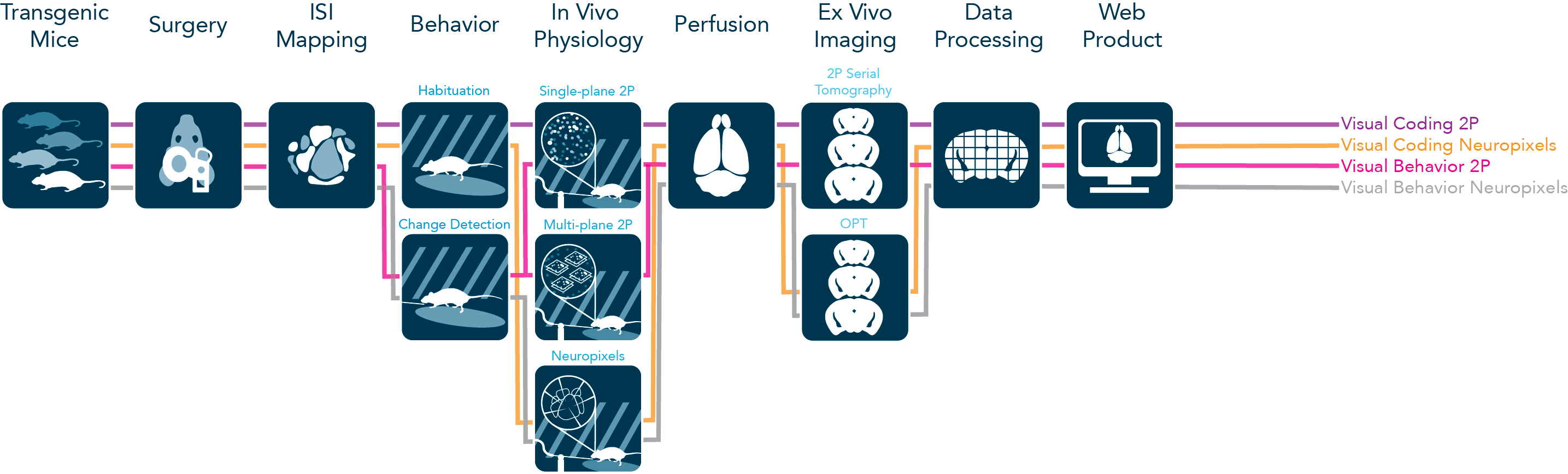
The Allen Brain Observatory presents the first standardized in vivo surveys of physiological activity in the mouse visual cortex. Dedicated teams carry out each step of the protocol as mice are prepared for experiments, cortical areas are mapped, and neural activity is recorded in response to a wide set of visual stimuli (schematized below)
2-photon calcium imaging: mouse visual cortex
Neuropixels: mouse cortex, hippocampus, thalamus
Our Approach
Our brains are unfathomably complex. Yet, for most people, using them to walk down the street or recognize familiar objects requires little effort. In order to make sense of how neurons work together to produce these everyday actions, we need to record the activity from many neurons in different brain regions. As part of the Behavior Circuits and Sensory Processing project, we record neural activity in mice engaged in cycles of perception and action—and do it on a scale larger than any attempted previously.
Visual Coding
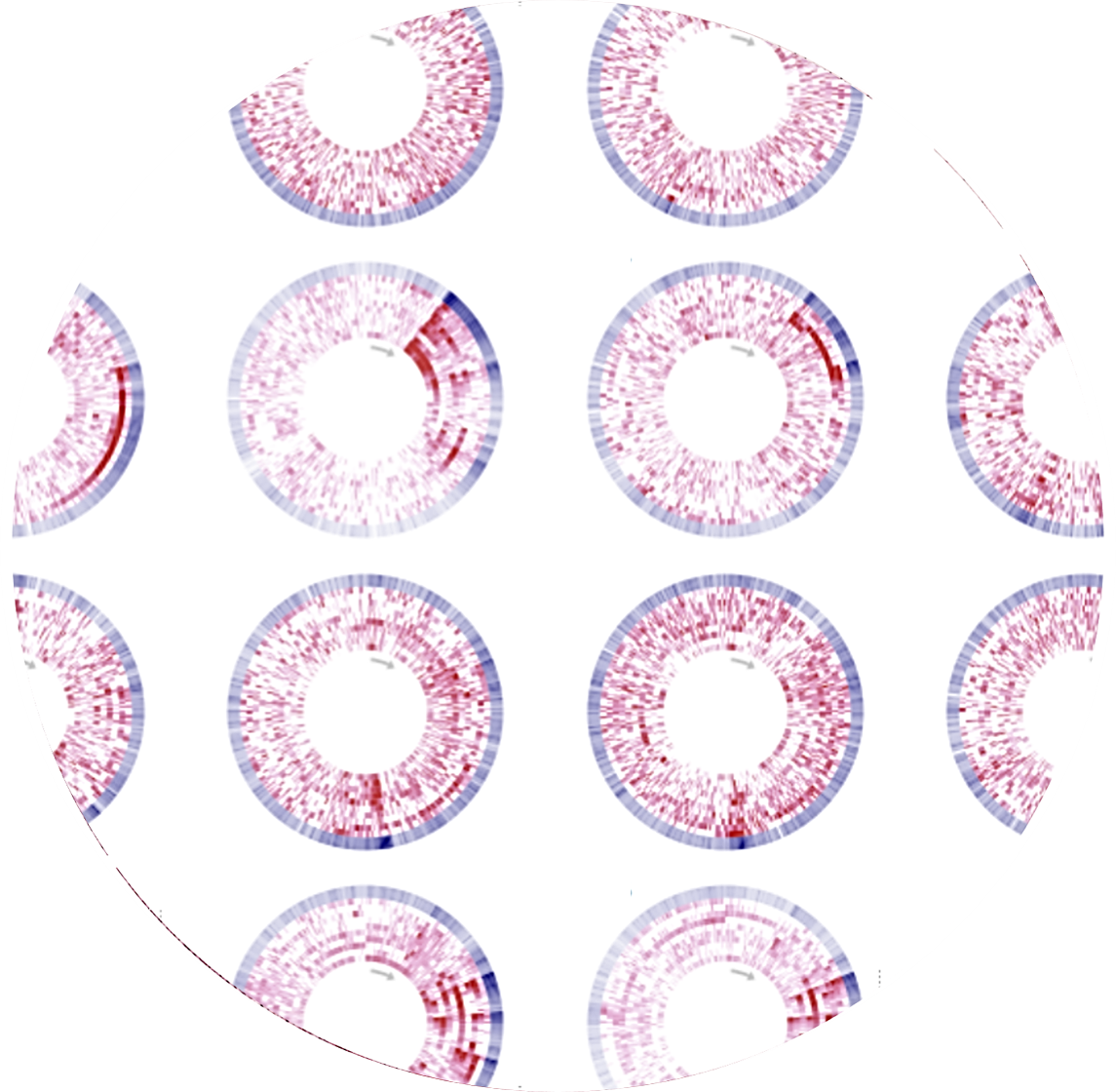
Using a broad range of visual stimuli, ranging from gratings and noise stimuli to natural images and movies, we have surveyed the spatial and temporal dynamics of visual representation in the mouse corticothalamic visual pathways.
This dataset can be used to address questions such as:
How are signals from the outside world represented in the brain, and how are signals relayed between brain regions?
Why is it important for mice (and humans) to have many visual areas?
What role do different cell types play in processing visual information?
Learn more about Visual Coding done via 2-Photon Ca+ Imaging or Neuropixels
Visual Behavior
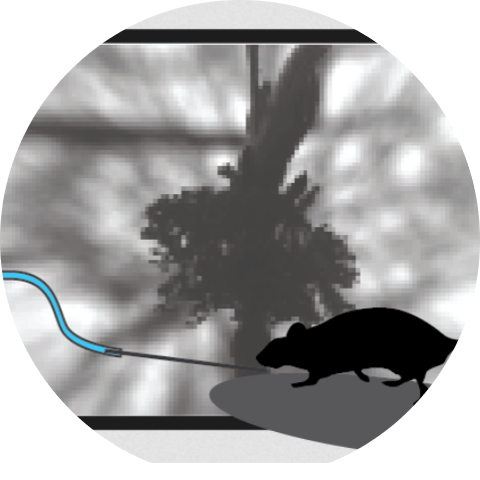
We have used large-scale physiological recordings in behaving animals to characterize how sensation and behavior are encoded in activity across the visual cortex and how these representations are influenced by behavior state, expectation, and experience during an image change detection task. Just like the Visual Coding project, the Visual Behavior project leverages the Allen Brain Observatories to collect highly standardized datasets.
This dataset can be used to address questions such as:
How do different types of neurons in the brain encode sensory and behavioral information?
Are these representations flexible depending on motivation or expectation?
How are interactions across cortical areas and depths modified by experience?
Learn more about Visual Behavior done via 2-Photon Ca+ Imaging or Neuropixels