Brainspan API Developmental Transcriptome

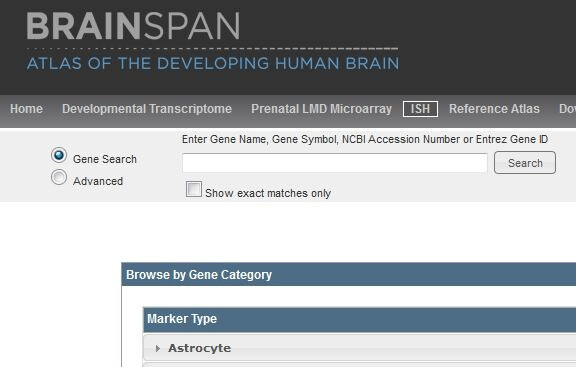
The BrainSpan Atlas of the Developing Human Brain is a foundational resource for studying transcriptional mechanisms involved in human brain development. The data includes:
- Developmental Transcriptome: RNA sequencing and exon microarray data profiling up to sixteen cortical and subcortical structures across the full course of human brain development
- Prenatal LMD Microarray: High-resolution neuroanatomical transcriptional profiles of ~300 distinct structures spanning the entire brain for four midgestional prenatal specimen
From the API, you can:

Download expression values

Query the correlative and differential search services
Developmental Transcriptome
Experimental Overview and Metadata
The Developmental Transcriptome Study is a broad developmental survey of gene expression in specific brain regions using RNA sequencing and exon microarray techniques. The survey profiles up to sixteen targeted cortical and subcortical structures across the full course of human brain development, spanning pre- and postnatal-development in both males and females.
Each sampling site is associated with a Structure. For convenience, surveyed structures are grouped together in the “Developing Human - Transcriptome” StructureSet.
Typically, for each sample four types of expression values are available:
- RNA-Seq RPKM values summarized to the gene level
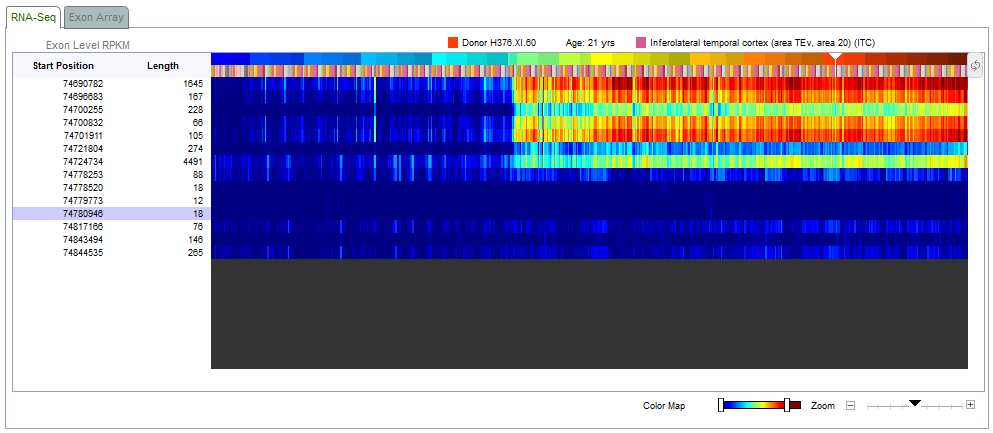
- RNA-Seq RPKM values summarized to the exon level
- Normalized exon microarray expression values summarized to the gene level
- Normalized exon microarray expression values summarized to the probeset level
Normalized expression values can be downloaded in several ways:
- From the web application Download page.
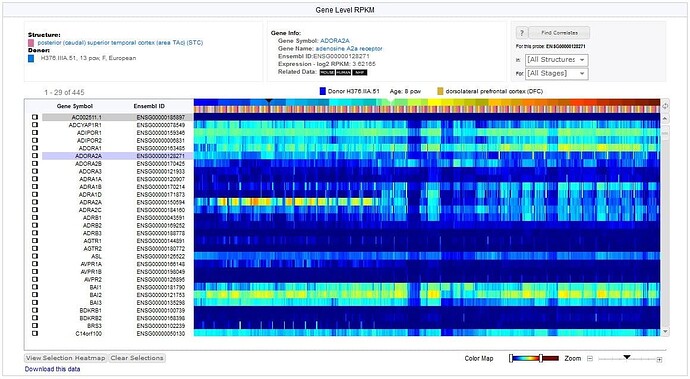
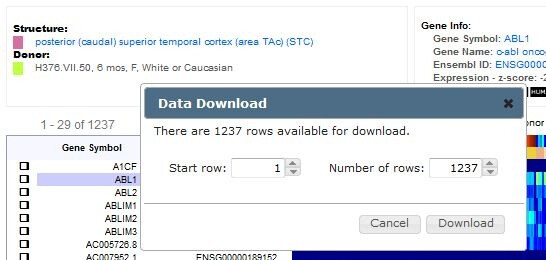
- From the “Download this data” link below the heatmap in the web application.
- From the connected data service in the API
All experimental data from this study is associated with the “Developing Human Transcriptome” Product. All gene, exon, probeset, donor and sampling site information can be accessed through the API using RMA queries.
Examples:
- All donors in the Product
http://api.brain-map.org/api/v2/data/Donor/query.xml?include=age&criteria=products[id$eq24]
- All samples in the Product
http://api.brain-map.org/api/v2/data/query.xml?criteria=model::Specimen, rma::criteria,donor(products[id$eq24]), well_known_files(well_known_file_type[name$eqRNASeqSummarizedToGenes]), rma::include,donor(age)
- All prenatal donors in the Product
http://api.brain-map.org/api/v2/data/query.xml?criteria=model::Donor, rma::criteria,products[id$eq24],rma::include,age[embryonic$eqtrue]
- All postnatal donors in the Product
http://api.brain-map.org/api/v2/data/query.xml?criteria=model::Donor, rma::criteria,products[id$eq24],rma::include,age[embryonic$eqfalse]
- All surveyed structures
http://api.brain-map.org/api/v2/data/query.xml?criteria=model::Structure, rma::criteria,structure_sets[name$eq’Developing Human - Transcriptome’], rma::options[only$eq’structures.id,structures.acronym,structures.name,structures.color_hex_triplet’]
Downloading Expression Values
Normalized expression values can be obtained by specifying:
- the required expression type (“set”),
- a list of “probes”,
- a list of donors (optional), and
- a list of structures (optional)
See the connected service page for definitions of service::dev_human_expression parameters.
|Expression Type | “set” parameter | “probe” object|
|— | — | —|
|RNA-Seq RPKM values summarized to the gene level | rna_seq_genes | Gene (ensembl_id not null )|
|RNA-Seq RPKM values summarized to the exon level | rna_seq_exons | GoExons|
|Exon microarray expression values summarized to the gene level | exon_microarray_genes | Gene (entrez_id not null )|
|Exon microarray expression values summarized to the probeset level | exon_microarray_exons | AffymetriProbsets|
RNA-Seq RPKM values summarized to the gene level
Example:
Download RNA-Seq expression values for samples from donor “h376.VI.52” associated with gene CARTPT
- Find Donor ID for “h376.VI.52” (id = 12890)
http://api.brain-map.org/api/v2/data/query.xml?criteria=model::Donor, rma::criteria,[name$eq’H376.VI.52’], rma::options[only$eq’donors.id’]
- Find Gene ID associated with gene CARTPT (id = 1098278)
http://api.brain-map.org/api/v2/data/query.xml?criteria=model::Gene, rma::criteria,[acronym$eq’CARTPT’][type$eq’EnsemblGene’],organism[name$eq’Homo Sapiens’], rma::options[only$eq’genes.id’]
- Use set = rna_seq_genes, Gene (“probe”) and Donor IDs as parameter to the service::dev_human_expression
http://api.brain-map.org/api/v2/data/query.json?criteria=service::dev_human_expression [set$eq’rna_seq_genes’][probes$eq1098278][donors$eq12890]
The output of the service is two top level ordered arrays “probes” and “samples”. For example:
“probes”:[ {“id”:1098278, “name”:“ENSG00000164326”, “gene-id”:9463, “gene-symbol”:“CARTPT”,“gene-name”:“CART prepropeptide”, “entrez-id”:9607,“chromosome”:“5”,“start-position”:“n/a”,“end-position”:“n/a”, “expression_level”:[“5.5566”,“4.9466”,“5.6331”,…]} ], “samples”:[ {“donor”:{“id”:12890,“name”:“H376.VI.52”,“age”:“4 mos”,“color”:“76EB76”}, “structure”:{“id”:10173,“name”:“dorsolateral prefrontal cortex”,“abbreviation”:“DFC”,“color”:“D4B235”}, “top_level_structure”:{“id”:10153,“name”:“neural plate”,“abbreviation”:“NP”,“color”:“D7D8D8”}}, {“donor”:{“id”:12890,“name”:“H376.VI.52”,“age”:“4 mos”,“color”:“76EB76”}, “structure”:{“id”:10185,“name”:“ventrolateral prefrontal cortex”,“abbreviation”:“VFC”,“color”:“C2A335”}, “top_level_structure”:{“id”:10153,“name”:“neural plate”,“abbreviation”:“NP”,“color”:“D7D8D8”}}, {“donor”:{“id”:12890,“name”:“H376.VI.52”,“age”:“4 mos”,“color”:“76EB76”}, “structure”:{“id”:10278,“name”:“anterior (rostral) cingulate (medial prefrontal) cortex”,“abbreviation”:“MFC”,“color”:“E26880”}, “top_level_structure”:{“id”:10153,“name”:“neural plate”,“abbreviation”:“NP”,“color”:“D7D8D8”}}, … ],
Each probe (Gene) contains information about:
- the Ensembl Gene (id, name), and
- the associated NCBI Gene (id, acronym, name, entrez-id), along with
- a vector of normalized expression values in the same order as the “samples” array.
Each sample contains information about:
- the Donor (id, name, age),
- the associated Structure (id, name, acronym and color), and
- the associated top (coarse) level Structure (id, name, acronym and color).
RNA-Seq RPKM values summarized to the exon level
Example:
Download RNA-Seq expression values for samples from donor “h376.VI.52” and all exons associated with gene CARTPT
- Find Donor ID for “h376.VI.52” (id = 12890)
http://api.brain-map.org/api/v2/data/query.xml?criteria=model::Donor, rma::criteria,[name$eq’H376.VI.52’], rma::options[only$eq’donors.id’]
- Find GoExons ID associated with gene CARTPT (id = 279330730,279330740,279330735)
http://api.brain-map.org/api/v2/data/query.xml?criteria=model::GoExon, rma::criteria,gene_association(gene[acronym$eq’CARTPT’]), rma::options[only$eq’go_exons.id’]
- Use set = rna_seq_exons, GoExon (“probe”) and Donor IDs as parameter to the service::dev_human_expression
http://api.brain-map.org/api/v2/data/query.json?criteria=service::dev_human_expression [set$eq’rna_seq_exons’][probes$eq279330730,279330740,2793307356][donors$eq12890]
The output of the service is two top level ordered arrays “probes” and “samples”. For example:
“probes”:[ {“id”:279330730, “name”:“ENSG00000164326”, “gene-id”:1098278, “gene-symbol”:“CARTPT”, “gene-name”:“CART prepropeptide”, “entrez-id”:9607,“chromosome”:“5”,“start-position”:71014989,“end-position”:71015279, “expression_level”:[“5.7282”,“4.8102”,“5.7152”, … ]}, {“id”:279330735, “name”:“ENSG00000164326”, “gene-id”:1098278,“gene-symbol”:“CARTPT”, “gene-name”:“CART prepropeptide”, “entrez-id”:9607,“chromosome”:“5”,“start-position”:71015405,“end-position”:71015790, “expression_level”:[“4.4128”,“3.8230”,“4.3135”, … ]}, {“id”:279330740, “name”:“ENSG00000164326”, “gene-id”:1098278,“gene-symbol”:“CARTPT”, “gene-name”:“CART prepropeptide”, “entrez-id”:9607,“chromosome”:“5”,“start-position”:71016334,“end-position”:71016875, “expression_level”:[“5.9593”,“5.4664”,“6.1137”, … ]} ], “samples”:[ {“donor”:{“id”:12890,“name”:“H376.VI.52”,“age”:“4 mos”,“color”:“76EB76”}, “structure”:{“id”:10173,“name”:“dorsolateral prefrontal cortex”,“abbreviation”:“DFC”,“color”:“D4B235”}, “top_level_structure”:{“id”:10153,“name”:“neural plate”,“abbreviation”:“NP”,“color”:“D7D8D8”}}, {“donor”:{“id”:12890,“name”:“H376.VI.52”,“age”:“4 mos”,“color”:“76EB76”}, “structure”:{“id”:10185,“name”:“ventrolateral prefrontal cortex”,“abbreviation”:“VFC”,“color”:“C2A335”}, “top_level_structure”:{“id”:10153,“name”:“neural plate”,“abbreviation”:“NP”,“color”:“D7D8D8”}}, {“donor”:{“id”:12890,“name”:“H376.VI.52”,“age”:“4 mos”,“color”:“76EB76”}, “structure”:{“id”:10278,“name”:“anterior (rostral) cingulate (medial prefrontal) cortex”,“abbreviation”:“MFC”,“color”:“E26880”}, “top_level_structure”:{“id”:10153,“name”:“neural plate”,“abbreviation”:“NP”,“color”:“D7D8D8”}}, … ],
Each probe (GoExon) contains information about:
- the GoExon (id, name), and
- the associated Ensembl Gene (id, acronym, name, entrez-id), along with
- a vector of normalized expression values in the same order as the “samples” array.
Each sample contains information about:
- the Donor (id, name, age),
- the associated Structure (id, name, acronym and color), and
- the associated top (coarse) level Structure (id, name, acronym and color).
Normalized exon microarray expression values summarized to the gene level
Example:
Download exon microarray expression values for samples from donor “h376.VI.50” associated with gene CARTPT
- Find Donor ID for “h376.VI.50” (id = 12296)
http://api.brain-map.org/api/v2/data/query.xml?criteria=model::Donor, rma::criteria,[name$eq’H376.VI.50’], rma::options[only$eq’donors.id’]
- Find Gene ID associated with gene CARTPT (id = 9463)
http://api.brain-map.org/api/v2/data/query.xml?criteria=model::Gene, rma::criteria,[acronym$eq’CARTPT’][type$eq’NcbiGene’],organism[name$eq’Homo Sapiens’], rma::options[only$eq’genes.id’]
- Use set = exon_microarray_genes, Gene (“probe”) and Donor IDs as parameter to the service::dev_human_expression
http://api.brain-map.org/api/v2/data/query.json?criteria=service::dev_human_expression [set$eq’exon_microarray_genes’][probes$eq9463][donors$eq12296]
The output of the service is two top level ordered arrays “probes” and “samples”. For example:
“probes”:[ {“id”:9463, “name”:“ENSG00000164326”, “gene-id”:9463, “gene-symbol”:“CARTPT”, “gene-name”:“CART prepropeptide”, “entrez-id”:9607,“chromosome”:“5”,“start-position”:“n/a”,“end-position”:“n/a”, “expression_level”:[“8.1073”,“5.9564”,“6.3102”,“7.0532”,“9.6157”,“7.1290”,“5.1168”,“4.4212”,“4.2779”], “z-score”:[“1.3547”,“0.0538”,“0.2678”,“0.7172”,“2.2670”,“0.7630”,“-0.4541”,“-0.8748”,“-0.9615”]} ], “samples”:[ {“donor”:{“id”:12296,“name”:“H376.VI.50”,“age”:“4 mos”,“color”:“80FF80”}, “structure”:{“id”:10278,“name”:“anterior (rostral) cingulate (medial prefrontal) cortex”,“abbreviation”:“MFC”,“color”:“E26880”}, “top_level_structure”:{“id”:10153,“name”:“neural plate”,“abbreviation”:“NP”,“color”:“D7D8D8”}}, {“donor”:{“id”:12296,“name”:“H376.VI.50”,“age”:“4 mos”,“color”:“80FF80”}, “structure”:{“id”:10243,“name”:“posterior (caudal) superior temporal cortex (area 22c)”,“abbreviation”:“STC”,“color”:“D670A0”}, “top_level_structure”:{“id”:10153,“name”:“neural plate”,“abbreviation”:“NP”,“color”:“D7D8D8”}}, … ]
Each probe (Gene) contains information about:
- the NCBI Gene (id), and
- the associated NCBI Gene (id, acronym, name, entrez-id), along with
- a vector of normalized expression values in the same order as the “samples” array, and
- a vector of z-score values in the same order as the “samples” array. Note: z-score is computed independently over all samples for each gene.
Each sample contains information about:
- the Donor (id, name, age),
- the associated Structure (id, name, acronym and color), and
- the associated top (coarse) level Structure (id, name, acronym and color).
Normalized exon microarray expression values summarized to a probeset level
Download exon microarray expression values for samples from donor “h376.VI.50” for all probesets associated with gene CARTPT
- Find Donor ID for “h376.VI.50” (id = 12296)
http://api.brain-map.org/api/v2/data/query.xml?criteria=model::Donor, rma::criteria,[name$eq’H376.VI.50’], rma::options[only$eq’donors.id’]
- Find AffymetrixProbeset ID associated with gene CARTPT (id = 280550735,280550750,280550740,280550730,280550745)
http://api.brain-map.org/api/v2/data/query.xml?criteria=model::AffymetrixProbeset, rma::criteria,gene_association(gene[acronym$eq’CARTPT’](organism[name$eq’Homo Sapiens’])), rma::options[only$eq’affymetrix_probesets.id’]
- Use set = exon_microarray_exons, AffymetrixProbeset (“probe”) and Donor IDs as parameter to the service::dev_human_expression
http://api.brain-map.org/api/v2/data/query.json?criteria=service::dev_human_expression [set$eq’exon_microarray_exons’][probes$eq280550735,280550750,280550740,280550730,280550745][donors$eq12296]
The output of the service is two top level ordered arrays “probes” and “samples”. For example:
“probes”:[ {“id”:280550735, “name”:“ENSG00000164326”, “gene-id”:9463, “gene-symbol”:“CARTPT”, “gene-name”:“CART prepropeptide”, “entrez-id”:9607,“chromosome”:“5”,“start-position”:71015125,“end-position”:71015265, “expression_level”:[“8.1073”,“6.4681”,“6.3102”,“7.0532”,“9.4350”,“7.1290”,“5.1560”,“5.0550”,“4.9879”], “z-score”:[“1.4783”,“0.0367”,“-0.1021”,“0.5513”,“2.6458”,“0.6179”,“-1.1171”,“-1.2059”,“-1.2649”]}, {“id”:280550750, “name”:“ENSG00000164326”, “gene-id”:9463, “gene-symbol”:“CARTPT”, “gene-name”:“CART prepropeptide”, “entrez-id”:9607,“chromosome”:“5”,“start-position”:71016613,“end-position”:71016799, “expression_level”:[“10.1951”,“8.8021”,“7.7846”,“9.4317”,“11.8110”,“10.0210”,“6.1850”,“5.6075”,“4.5526”], “z-score”:[“1.2342”,“0.6566”,“0.2348”,“0.9177”,“1.9041”,“1.1620”,“-0.4284”,“-0.6678”,“-1.1052”]}, ], “samples”:[ {“donor”:{“id”:12296,“name”:“H376.VI.50”,“age”:“4 mos”,“color”:“80FF80”}, “structure”:{“id”:10278,“name”:“anterior (rostral) cingulate (medial prefrontal) cortex”,“abbreviation”:“MFC”,“color”:“E26880”}, “top_level_structure”:{“id”:10153,“name”:“neural plate”,“abbreviation”:“NP”,“color”:“D7D8D8”}}, {“donor”:{“id”:12296,“name”:“H376.VI.50”,“age”:“4 mos”,“color”:“80FF80”}, “structure”:{“id”:10243,“name”:“posterior (caudal) superior temporal cortex (area 22c)”,“abbreviation”:“STC”,“color”:“D670A0”}, “top_level_structure”:{“id”:10153,“name”:“neural plate”,“abbreviation”:“NP”,“color”:“D7D8D8”}}, … ]
Each probe (Gene) contains information about:
- the AffymetrixProbeset (id), and
- the associated NCBI Gene (id, acronym, name, entrez-id), along with
- a vector of normalized expression values in the same order as the “samples” array, and
- a vector of z-score values in the same order as the “samples” array. Note: z-score is computed independently over all samples for each gene.
Each sample contains information about:
- the Donor (id, name, age),
- the associated Structure (id, name, acronym and color), and
- the associated top (coarse) level Structure (id, name, acronym and color).
Differential Search
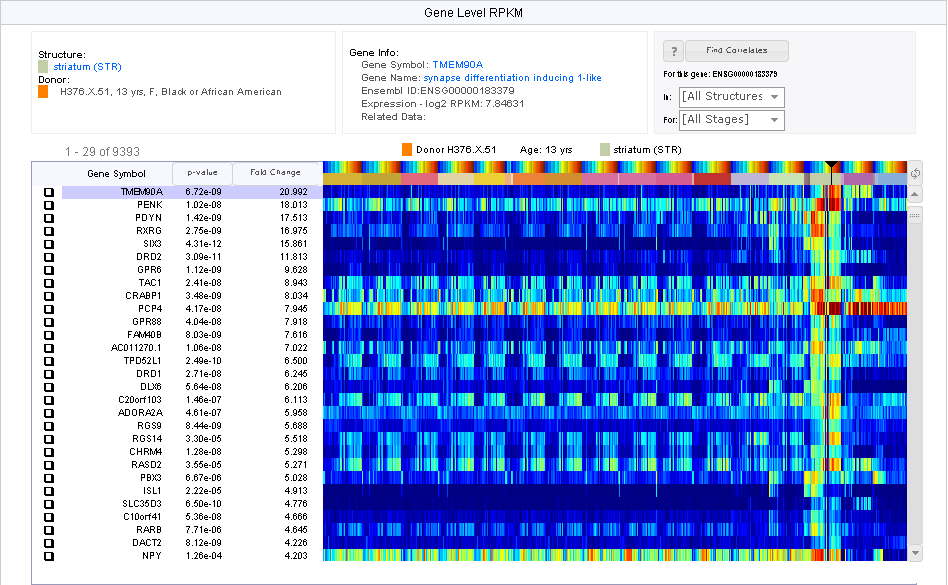
Differential search find “probes” that show the greatest difference in expression values between two sets (target and contrast) of user-defined structures. For each probe, a 2-sample t-test is performed followed by Benjamini and Hochberg false discovery rate correction. The null hypothesis is that the average expression level of samples in the contrast set of structures is greater than or equal to the average expression level of samples in the target set of structures. A statistically significant result (p-value less than user-defined threshold) allows us to reject the null hypothesis and conclude that the average expression level of samples in the target set of structures is greater than the average expression level of samples in the contrast set of structures. Resulting p-values are sorted in ascending order. Search results can also be sorted by fold-change (log ratio of expression) in descending order.
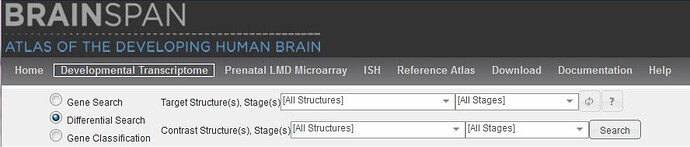
The differential search function can be accessed through the Web application or using the API.
See the connected service page for definitions of service::dev_human_differential parameters.
Example:
Differential search for genes with higher expression in “striatum” than in the whole “neural plate” over all donors for each of the four types of expression data.
- Find Structure ID for “striatum” (id = 10333 )
http://api.brain-map.org/api/v2/data/query.xml?criteria=model::Structure, rma::criteria,[name$il’striatum’],ontology[name$eq’Developing Human Brain Atlas’], rma::options[only$eq’structures.id’]
- Find Structure ID for “neural plate” (id = 10153)
http://api.brain-map.org/api/v2/data/query.xml?criteria=model::Structure, rma::criteria,[name$il’neural plate’],ontology[name$eq’Developing Human Brain Atlas’], rma::options[only$eq’structures.id’]
- Differential search for gene-level RNA-Seq data (set = rna_seq_genes)
http://api.brain-map.org/api/v2/data/query.xml?criteria=service::dev_human_differential [set$eq’rna_seq_genes’][structures1$eq10153][structures2$eq10333][sort_by$eq’fold-change’]
- Differential search for exon-level RNA-Seq data (set = rna_seq_exons )
http://api.brain-map.org/api/v2/data/query.xml?criteria=service::dev_human_differential [set$eq’rna_seq_exons’][structures1$eq10153][structures2$eq10333][sort_by$eq’fold-change’]
- Differential search for gene-level exon microarray data (set = exon_microarray_genes )
http://api.brain-map.org/api/v2/data/query.xml?criteria=service::dev_human_differential [set$eq’exon_microarray_genes’][structures1$eq10153][structures2$eq10333][sort_by$eq’fold-change’]
- Differential search for probeset-level exon microarray data (set = exon_microarray_exons )
http://api.brain-map.org/api/v2/data/query.xml?criteria=service::dev_human_differential [set$eq’exon_microarray_exons’][structures1$eq10153][structures2$eq10333][sort_by$eq’fold-change’]
Example:
Differential search for genes with higher expression at 8-9 pcw than at 10-12 pcw over the whole “neural plate” for each of the four types of expression data.
- Find Structure ID for “neural plate” (id = 10153)
http://api.brain-map.org/api/v2/data/query.xml?criteria=model::Structure, rma::criteria,[name$il’neural plate’],ontology[name$eq’Developing Human Brain Atlas’], rma::options[only$eq’structures.id’]
- Find Donor IDs for donors within age 8-9 pcw (id = 12833,13058)
http://api.brain-map.org/api/v2/data/query.xml?criteria=model::Donor, rma::criteria,products[name$eq’Developing Human Transcriptome’],age[embryonic$eqtrue][days$ge56][days$le63], rma::options[only$eq’donors.id’]
- Find Donor IDs for donors within age 10-12 pcw (id = 12835,12960,13060)
http://api.brain-map.org/api/v2/data/query.xml?criteria=model::Donor, rma::criteria,products[name$eq’Developing Human Transcriptome’],age[embryonic$eqtrue][days$ge70][days$le84], rma::options[only$eq’donors.id’]
- Differential search for gene-level RNA-Seq data (set = rna_seq_genes)
http://api.brain-map.org/api/v2/data/query.xml?criteria=service::dev_human_differential [set$eq’rna_seq_genes’][donors1$eq12835,12960,13060][donors2$eq12833,13058] [structures1$eq10153][structures2$eq10153][sort_by$eq’fold-change’]
- Differential search for exon-level RNA-Seq data (set = rna_seq_exons )
http://api.brain-map.org/api/v2/data/query.xml?criteria=service::dev_human_differential [set$eq’rna_seq_exons’][donors1$eq12835,12960,13060][donors2$eq12833,13058] [structures1$eq10153][structures2$eq10153][sort_by$eq’fold-change’]
- Differential search for gene-level exon microarray data (set = exon_microarray_genes )
http://api.brain-map.org/api/v2/data/query.xml?criteria=service::dev_human_differential [set$eq’exon_microarray_genes’][donors1$eq12835,12960,13060][donors2$eq12833,13058] [structures1$eq10153][structures2$eq10153][sort_by$eq’fold-change’]
- Differential search for probeset-level exon microarray data (set = exon_microarray_exons )
http://api.brain-map.org/api/v2/data/query.xml?criteria=service::dev_human_differential [set$eq’exon_microarray_exons’][donors1$eq12835,12960,13060][donors2$eq12833,13058] [structures1$eq10153][structures2$eq10153][sort_by$eq’fold-change’]
Correlative Search
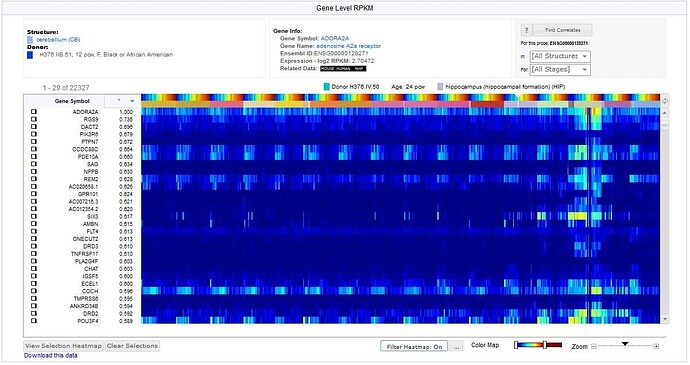
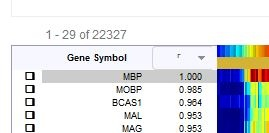
Correlative search finds “probes” with expression profile similar that of a to a selected seed “probe” over all samples within a user-specified structure and for user-specified donors. Pearson’s correlation coefficient is computed for all probes and the results ranked in descending order.
The correlative search function can be accessed through the Web application or using the API.
See the connected service page for definitions of service::dev_human_correlation parameters.
Example:
Correlative search for “probes” with similar expression to PVALB over the whole brain
- Correlative search for gene-level RNA-Seq data ( seed ?Ensembl Gene id = 1089164, set = rna_seq_genes )
http://api.brain-map.org/api/v2/data/query.xml?criteria= service::dev_human_correlation[set$eqrna_seq_genes][probes$eq1089164][structures$eq10153]
- Correlative search for exon-level RNA-Seq data ( seed GoExon id = 278724739, set = rna_seq_exons )
http://api.brain-map.org/api/v2/data/query.xml?criteria= service::dev_human_correlation[set$eqrna_seq_exons][probes$eq278724739][structures$eq10153]
- Correlative search for gene-level exon microarray data (seed NCBI Gene id = 5784, set = exon_microarray_genes )
http://api.brain-map.org/api/v2/data/query.xml?criteria= service::dev_human_correlation[set$eqexon_microarray_genes][probes$eq5784][structures$eq10153]
- Correlative search for probeset-level exon microarray data ( seed AffymetrixProbeset id = 281337753, set = exon_microarray_exons )
http://api.brain-map.org/api/v2/data/query.xml?criteria= service::dev_human_correlation[set$eqexon_microarray_exons][probes$eq281337753][structures$eq10153]