SEA-AD code and analysis tools
The Seattle Alzheimer’s Disease Brain Cell Atlas (SEA-AD) consortium strives to gain a deep molecular and cellular understanding of the early pathogenesis of Alzheimer’s disease. This page includes links to code repositories affiliated with SEA-AD members and/or using SEA-AD data, including code-bases for SEA-AD manuscripts and models.
(For access to all SEA-AD data and documentation, visit the parent SEA-AD Data and Downloads page.)

Access SEA-AD data
Code-based entry points into some of our data. Visit Our Data for access to all SEA-AD data sets.
Access single nucleus RNA-seq data
Access single nucleus RNA-seq data from multiple neocortical and allocortical areas and from caudate nucleus through the Allen Brain CellAtlas (ABC Atlas) Access toolkit. This resources provides public access toAWS-hosted datasets in standardized formats alongside example notebooks andAPIs to perform reproducible analyses of the released data. These data setswill be available via the ABC Atlas web application soon!
Analyze your own data
SEA-AD analysis modules include neuropathology models, single-cell mapping algorithms, and other specialized tools.
MapMyCells mapping
MapMyCells allows users to assign cell type names from AllenInstitute-hosted taxonomies to their own single cell and spatialtranscriptomics data. This repository includes code for applying hierarchicalcorrelation mapping to your own data. Note that this is not the defaultmapping method for SEA-AD taxonomies in the MapMyCells GUI.
Iterative_scANVI mapping
Iterative_scANVI mapping provides the code used to integrateand harmonize SEA-AD caudate single-nucleus transcriptomic data with existinghuman brain reference taxonomies. This method is similar to the deepgenerative mapping method for SEA-AD taxonomies in the MapMyCells GUI.
B-BIND: defining pseudoprogression
The Biophysical Bayesian Inference For NeurodegenerativeDynamics (B-BIND) repository provides the implementation of the Bayesiandisease-progression framework described by Agrawal et al. Using neuropathologymeasurements from cross-sectional samples, it estimates a continuous diseasepseudotime and latent disease states, enabling characterization of the temporalprogression of Alzheimer’s disease and the biological changes associated withdifferent stages of pathology.
Reproduce our science
Code repositories for reproducing analyses from SEA-AD manuscripts and preprints.
Multiregional single-cell profiling reveals shared andspecialized cellular vulnerability in Alzheimer’s disease (2026)
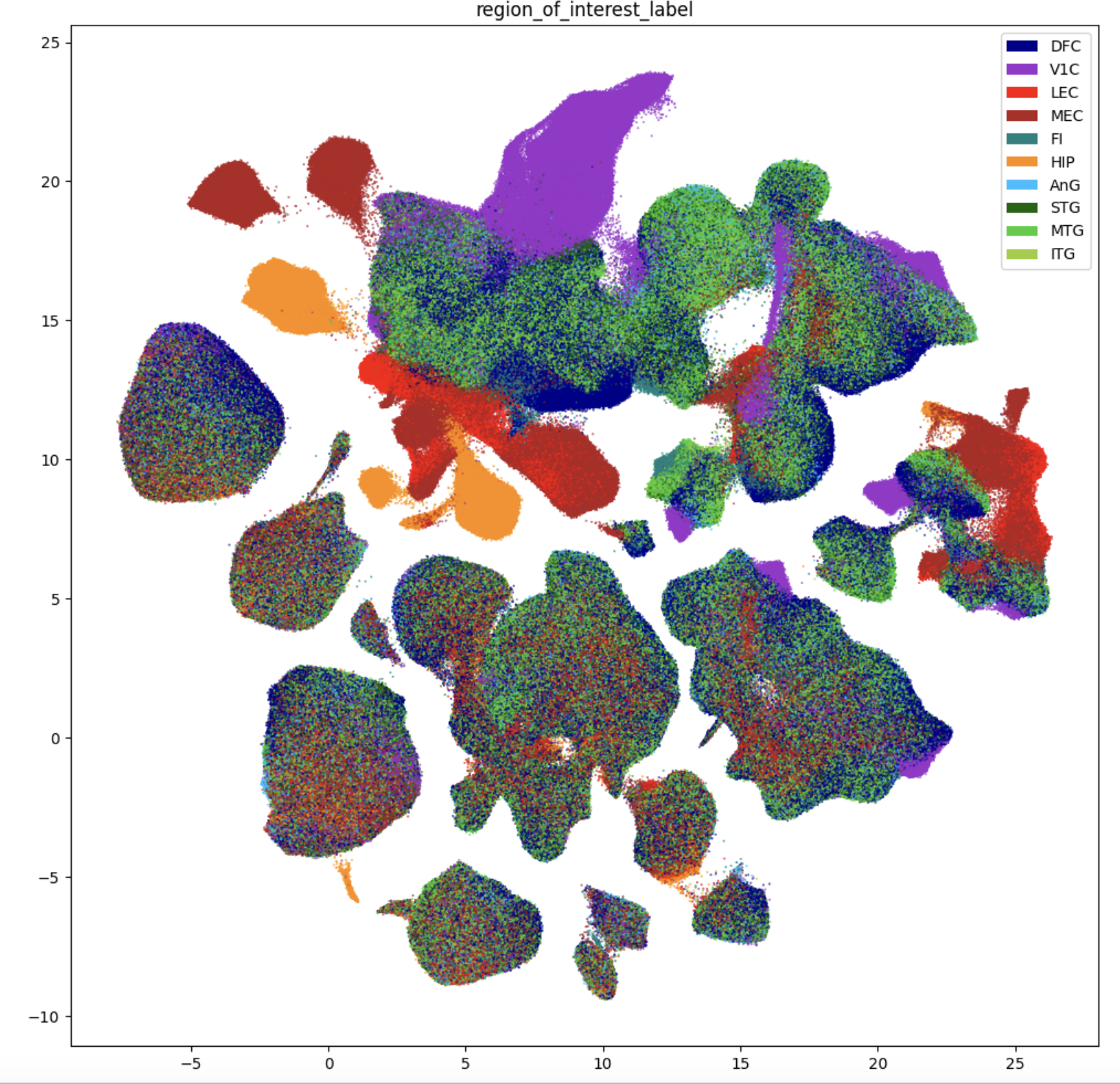
This repository contains the primary analysis andfigure-generation code for the SEA-AD multiregion study, which extends SEA-ADacross ten cortical and allocortical brain regions and integrates single-cellgenomics, neuropathology, and genetic data from the same donor cohort. Itincludes workflows for cell-type mapping, pseudo-progression modeling ofAlzheimer's disease pathology, differential abundance and expression analyses,genetic association studies, and replication across multiple independentcommunity cohorts, enabling reproduction of the major findings andvisualizations presented in the manuscript.
The Caudate Nucleus Exhibits Distinct Pathology and Cell Type-Specific Responses Across Alzheimer’s Disease (2026)
These repositories comprise the primary analysis code basefor the SEA-AD caudate atlas paper, covering single-cell atlas integration,spatial transcriptomics processing, differential abundance and differentialexpression analyses, and figure reproduction. Collectively, they provide thecomputational workflows needed to reproduce the major results andvisualizations presented in the manuscript.
Integrated multimodal cell atlas of Alzheimer’s disease (2024)
Primary public code repository for our initial studydescribing the creation of a massive molecular and cellular atlas of middletemporal gyrus. Includes modality-specific preprocessing notebooks forquantitative neuropathology, single-nucleus omics, spatial transcriptomics,Patch-seq, and figure reproduction code.
